The Details
The Site
San Pablo Neighborhood, Sevilla, Spain
Pl. de la Debla, 10, 41007 Sevilla, Spain
92VJ+G8 or 37.393618N, -5.969496 W
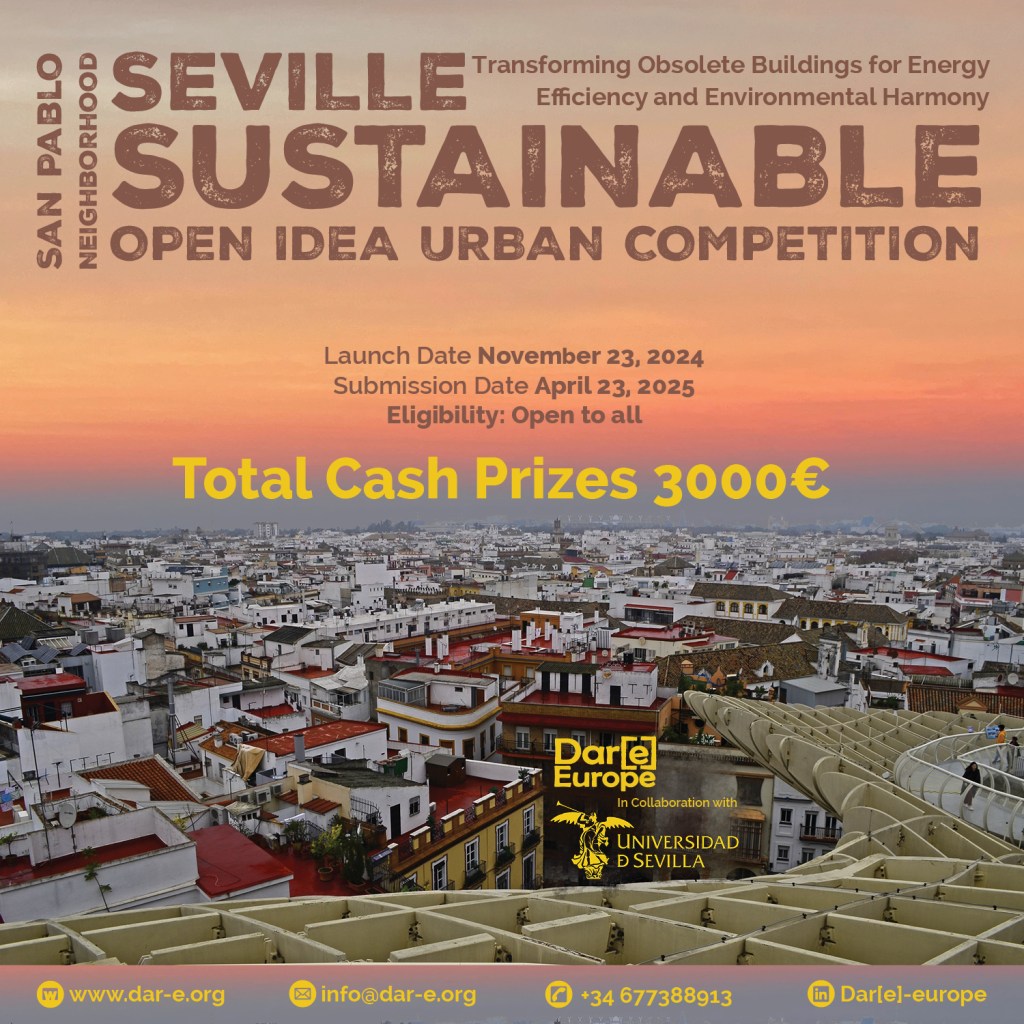
The site is part of a larger neighborhood divided into numerous blocks. This competition focuses on one of these smaller blocks (identified by the coordinates and name above). The challenge is not to propose a new building but to develop innovative solutions for refurbishing the existing social housing structures. The San Pablo neighborhood is dedicated entirely to social housing, with buildings ranging from 5 to 12 stories tall. These structures, built in the last century, have aged significantly and are in urgent need of refurbishment. Current sustainable design discourse emphasizes refurbishment over demolition or new construction, aligning with the goals of this competition. While the site is located in Seville, the challenge and proposed solutions are intended to have broader relevance. Social housing exists across all European cities, making this competition’s outcomes applicable beyond Seville and relevant to diverse urban contexts.
Competition Goals
The primary objective of this refurbishment is to reduce the CO₂ impact of the intervention while ensuring the buildings consume less energy and provide enhanced comfort for their residents. Seville’s Csa Mediterranean climate—characterized by hot, dry summers—presents a unique design challenge. With average summer temperatures in the high 30°C range and peaks exceeding 40°C, the main focus should be on creating cool and comfortable indoor environments for residents during these extreme conditions. This competition provides an opportunity to address a pressing urban issue, explore sustainable refurbishment strategies, and contribute to the global dialogue on social housing retrofits.
The program
This competition does not prescribe a fixed program for the intervention. Instead, participants are tasked with improving the thermal performance of the buildings on the site. The focus should be on refurbishing the façades, roofs, and internal partitions to enhance energy efficiency and sustainability.
Buildings Inventory: the intervention site contains the following buildings:
- Type A: One building, 12 floors, consisting of a single typical floor design.
- Type B: One building, 8 floors, with each floor comprising two adjacent units.
- Type C: Seven buildings, 5 floors each: Five buildings are linear, The other two seperated
- Type D: Three single-story units: you are free to remove, alter or refurbish these structures
The Sustainable Edge
Refurbishment is already a significant step toward sustainability. In this competition, we challenge you to take it further by incorporating concepts of green design, low-energy use, zero or near-zero energy buildings, and bioclimatic principles. For Dar[e], sustainability means creating projects that ensure user comfort while minimizing reliance on non-renewable energy sources and reducing environmental impact. Below, we outline key considerations for your submissions, highlighting what is of utmost importance (+++) and what holds basic importance (+):
Key Considerations
- Material Choice (Embedded Energy) (+)
- Prioritize materials with lower embedded energy to minimize the project’s carbon footprint.
- Passive Design Strategies (+++)
- 2a- Solar Geometry: Optimize orientation, window placement, and shading devices for thermal comfort and natural lighting.
- 2b- Ventilation: Incorporate natural and/or forced ventilation to reduce overheating.
- 2c- Material Selection: Use materials that enhance thermal performance and efficiency.
- Environmental Impact (+)
- Minimize disruption to the natural environment, preserving or enhancing habitats.
- Manage waste efficiently and harvest natural resources intelligently.
- Integration of Active Systems (+)
- Incorporate renewable energy systems and efficient technologies to complement passive strategies.
Focus Area
Refurbishment directly impacts embedded energy and environmental considerations, making it an essential foundation for sustainable design. This competition emphasizes passive design strategies, material choices, and system integration. Proposed solutions must address these challenges without creating unforeseen issues. Take refurbishment to the next level and show us how you’ll make Seville’s buildings sustainable, efficient, and environmentally harmonious
Deliverables
1 cover sheet + 2 A1 Sheets + 2 A4 text
- Overall mass plan showing all interventions
- Floor plans of the various building types.
- Elevations of the various building types, (section if needed)
- Technical drawing for the piazza proposal
- Technical sketches explaining the choice of materials, the construction details, and how the new/proposed systems would fit and would be successful in reaching their goal
- Maps and Purpose of added active system, if added and if used
- At least two perspectives to show the two piazzas and surrounding intervention on buildings.
- Two A4 sheet with a text of not less than 400 and not more than 800 words explaining your intervention, including at least one figure and not more than three figures.
- One A4 with only one overall perspective view (to be used as the main cover for eventual publication later) can be a perspective already used in the main sheets
Important Notes
- Entries with interesting technical proposal might be selected to be further developed in collaboration with Dar[e]-europe and University of Seville, to become worthy of publication in dedicated conferences and or scientific journal
- Simulation and calculations could be carried out on selected proposals with outstanding proposals to be further developed in collaboration with Dar[e]-europe, University of Seville, and the team(s) to become worthy of publication in dedicated research journal.
Important Dates
- Two categories of team registration are available:
- Corporate
- Freelance
The different is that the corporate team will include the affiliated name of the University, the firm or the office the team would be representing. Whereas the freelance team only represent the individuals making it with no affiliation.
Pre-Launch November 15
Official Launch Date November 23 (all details are available and registration open)
Regular Registration 75 EUR & 90 EUR (Corporate) ends March 5
Late Registration 90 EUR & 120 EUR (Corporate) ends April 5
Extended Late Registration 110 EUR & 150 EUR (Corporate) ends April 30
Queries period ends April 10
Submission Date May 3, 2025 @ 11:59 pm
Results announced between Mid June
 Dar[e]urope